
Textile ETP launches textile bioeconomy strategy, calling for urgent collective action to anchor biobased and circular value chains in Europe
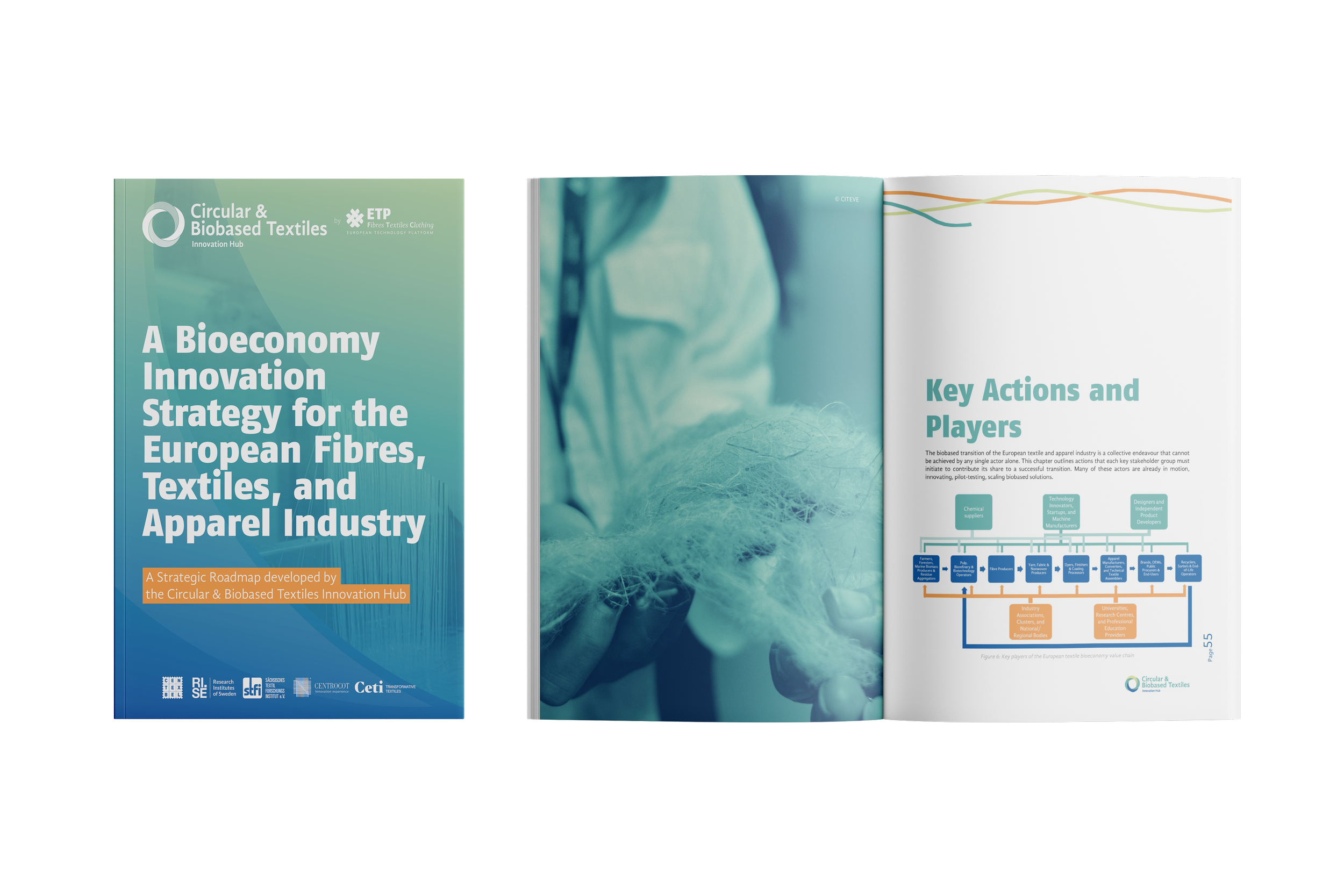
On 22 September 2026, Textile ETP's Circular & Biobased Textiles Innovation Hub published its strategy for the biobased and circular transformation of Europe's textile and apparel industry.
Launched during the 4th ECOSYSTEX Conference in Antwerp, and developed by Textile ETP between February and August 2026 together with experts from across the European biotextile value chain through the Circular & Biobased Textiles Innovation Hub, the Bioeconomy Innovation Strategy for the European Fibres, Textiles, and Apparel Industry sets out how Europe can halt and reverse five decades of rising fossil dependency in its textile material base and at the same time strengthen its manufacturing base.
The strategy identifies three converging imperatives that make the biobased transition a necessity rather than an option: sustainability (as global per-capita fibre consumption climbs, with the additional demand met almost entirely by fossil synthetics), strategic resilience (given that over 90% of global polyester capacity already is located in Asia and other man-made fibres following the same trajectory, Europe increasingly depends on a handful of non-European suppliers for most of its strategic textime material supply), and competitiveness (in line with the EU Bioeconomy Strategy and the upcoming Biotech Act II biomaterial and bioprocess innovation can unlock unique competitive advantages and IP-based differentiation for EU-based manufacturers).
“Europe’s textile bioeconomy is not only a sustainability opportunity, it is an industrial opportunity. Reversing decades of rising fossil dependence can strengthen competitiveness, resilience and strategic autonomy, while creating new industrial value and high-quality jobs. The choice is ours.”
Marina Crnoja-Cosic, President, Textile ETP
The strategy charts a path toward a biobased and circular European textile industry by 2050, in which biobased and circular materials account for at least half of all fibre consumed in the EU and the value chain that produces them is rooted in Europe. The vision covers four interlocking layers (feedstock, bio-processing and refining, fibre and material production, and market, demand and end-of-life) and five core building blocks: biobased feedstock and biorefinery processes, sustainable man-made cellulosic fibres, biosynthetics and novel biopolymer fibres, sustainably sourced natural fibres, and bio-chemistry and biobased processing.
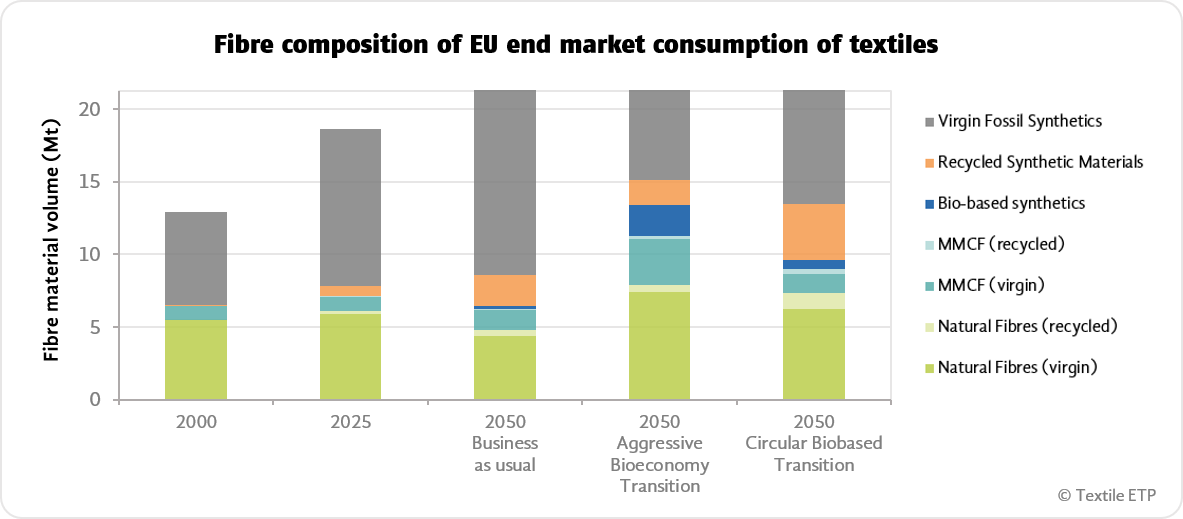
Evolution and fibre composition of EU textile end market consumption 2000-2050
The strategy is grounded in a purpose-built quantitative model of EU-27 textile fibre consumption from 2000 to 2050, covering seven end markets and eleven fibre types across three scenarios: a business-as-usual path on which the fossil share of Europe's fibre base keeps drifting upwards and EU industry competitiveness declines; a circular biobased path driven by balanced incentivisation and investment in recycling and bioeconomy innovation and capacity; and an aggressive bioeconomy path built on a highly focused drive towards biomanufacturing and biobased materials and processes. The strategy calls for all stakeholders to work together targeting an outcome between the latter two, in which renewable materials make up the majority of EU fibre consumption by 2050 and the value chain producing them is anchored in Europe, mobilising tens of billions of euros a year across the EU value chain and tens of thousands of direct jobs.
The roadmap also presents ten recommendations to EU policy makers, combining supply-side support (recognition, research funding, biorefinery capacity) with demand-side pull (procurement, legislation, trusted sustainability claims), and insisting that both reach the SMEs that make up industrial backbone of the sector.
Finally, the strategy identifies five cross-cutting actions that no single stakeholder can accomplish alone: co-developing regional bio-manufacturing hubs that integrate feedstock production, primary processing, fibre and material production, finishing and circular end-of-life infrastructure; building cross-sector value chains between agriculture, forestry, pulp and paper, chemicals, biotechnology and textiles; establishing robust sustainability assessment methodologies, standards and traceability for bio-based textile materials and processes including verified sustainable bio-origin and mass-balance accounting; forming demand-side coalitions to scale bio-based textile capacity through green public procurement and reliable off-take agreements; and developing a pan-European bio-textile skills and talent pipeline.
Concrete implementation strategies for the key recommendations will be developed throughout the remainder of 2026 and into 2027, with all interested stakeholders invited to join.
